China Best Self Car Wash Equipment for Global Buyers?
China Best Self Car Wash Equipment for Global Buyers? The question deserves more than a low-price comparison. Grand View Research valued the global car wash services market at approximately USD 34.59 billion in 2022. Its 2023–2030 analysis also projects steady growth, supported by urbanization, vehicle ownership, and professional cleaning demand. Mordor Intelligence’s 2024–2029 market report similarly identifies automation, water efficiency, and convenient payment systems as important industry drivers.
For buyers, Self Car Wash Equipment should be judged through practical operating details. Consider high-pressure pumps, foam brushes, vacuum motors, control panels, and winter protection. A reliable system should also support local voltage, language settings, payment methods, and maintenance access. In a busy site, a blocked hose or weak coin validator can stop revenue within minutes. That reality matters more than attractive catalog images.
China offers broad manufacturing capacity and flexible customization. Some factories provide ISO 9001 quality systems, CE documentation, water-recycling modules, and remote technical support. However, certificates alone do not prove long-term performance. Buyers should request test videos, component brands, factory inspection records, spare-parts lists, and references from similar climates. This is where evaluation becomes less convenient. Market reports often measure car wash services, not equipment failure rates. Their forecasts are useful, but not perfect. A better decision combines published data with installation evidence, total operating cost, and local service capability. The best supplier may not offer the lowest quotation. It should deliver stable cleaning pressure, simple maintenance, and dependable support after shipment.
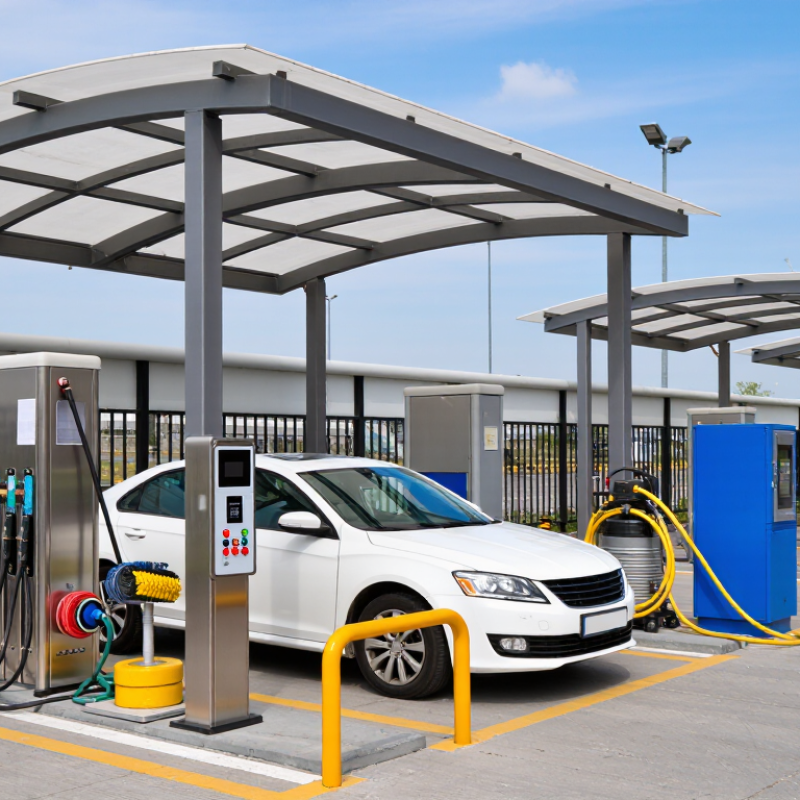
What Is Self Car Wash Equipment and How Does It Work?
Self car wash equipment lets drivers clean their vehicles without hiring an attendant. A typical bay includes a high-pressure pump, spray wand, foam brush, vacuum, control panel, and payment system. The customer selects a program, then moves through pre-rinse, foaming, washing, and final rinsing. Some systems also provide wax application and air drying.
The pump draws water from a storage tank or mains supply and sends it through heated or unheated lines. A pressure regulator keeps the spray strong but controlled. The timer measures each service, while valves switch between chemicals and water. Drainage channels carry used water toward filtration or recovery equipment. Reclaimed water can reduce consumption, but it may need extra treatment for clear final rinsing. Local water, electrical, and drainage rules still matter.
For global buyers comparing equipment made in China, practical testing is more useful than attractive specifications. Check voltage compatibility, pump flow, hose quality, emergency stops, winter protection, and spare-part availability. Ask for operating videos, maintenance schedules, and realistic daily capacity. A polished brochure is not proof. Small details matter, such as a wet control panel or a hose that kinks in cold weather. No system is perfect. Buyers should inspect these weaknesses before installation and confirm technical support across time zones.
China Best Self Car Wash Equipment for Global Buyers? - What Is Self Car Wash Equipment and How Does It Work?
| Data Dimension | Typical Information | How It Works or Why It Matters | Global Buyer Considerations |
|---|---|---|---|
| Definition | A customer-operated vehicle-washing system that allows drivers to select and control washing functions without a full-service attendant. | The user activates timed wash stages through a control panel, payment terminal, token system, or digital payment interface. | Confirm local regulations for unattended commercial equipment, electrical safety, water discharge, and accessibility. |
| Main Equipment Types | Self-service pressure-wash bay, in-bay automatic wash, vacuum station, mat-cleaning station, and combination wash-and-vacuum site. | Pressure-wash bays require the driver to operate a spray lance, while automatic systems move brushes, cloth materials, or spray arches around a stationary vehicle. | Select the configuration according to land size, expected traffic, labor availability, climate, and customer preferences. |
| Core Components | High-pressure pump, electric motor, spray gun and lance, hose reel, control box, chemical injector, payment controller, water-treatment equipment, and safety devices. | The controller activates selected functions, the pump pressurizes water, and the chemical system adds detergent, foam, wax, or other approved solutions. | Check compatibility with local voltage, frequency, plug standards, pipe connections, detergents, and replacement parts. |
| Typical Operating Pressure | Approximately 70–150 bar for many self-service pressure-wash applications, depending on vehicle type, nozzle, pump, and local requirements. | Higher pressure removes mud and road film more effectively, but excessive pressure or incorrect spray distance may damage paint, trim, seals, or decals. | Request verified pump specifications and ensure the selected pressure is suitable for passenger cars, vans, or commercial vehicles. |
| Water Flow Rate | Common pressure-wash flow rates are about 8–15 litres per minute per active spray gun; the actual rate depends on the nozzle and pump. | Water is delivered through a calibrated nozzle that balances cleaning performance, pressure, operating cost, and wastewater volume. | Size the water supply, storage tank, drainage, and recycling system for the maximum number of simultaneous bays. |
| Typical Wash Sequence | Pre-rinse, high-pressure wash, detergent or foam, brush wash where applicable, rinse, spot-free rinse, and optional wax or drying cycle. | Each program is assigned a timed stage. The customer changes programs using a selector, push button, touchscreen, or mobile payment interface. | Program names, chemical labels, user instructions, and warning signs should be translated into the local language. |
| Average Customer Cycle | Approximately 5–12 minutes for a basic self-service wash, although the duration varies with the selected programs and vehicle condition. | The control system deducts time or payment credit while the selected function is running and stops or changes functions when the credit expires. | Longer cycles may improve convenience but reduce bay turnover during peak periods; adjustable timers can support different pricing models. |
| Power Supply | Many commercial systems use three-phase electricity, commonly 380–415 V at 50 Hz in applicable markets; other regional configurations are available. | Electric motors drive the high-pressure pumps, while control circuits operate valves, timers, payment units, lighting, and auxiliary equipment. | Electrical ratings must be confirmed by a qualified local electrician before installation. Voltage and frequency should match the site supply. |
| Water Treatment | Possible equipment includes sediment filters, water softeners, reverse-osmosis units, spot-free rinse systems, and wastewater recycling systems. | Treatment reduces suspended solids, hardness minerals, and dissolved contaminants that can cause spots, scale, or equipment wear. | The correct configuration depends on incoming water quality, municipal rules, discharge requirements, and desired finish quality. |
| Payment Options | Coin and token acceptors, bank-card terminals, contactless payments, QR-code payments, prepaid accounts, and centrally managed payment systems. | The payment controller converts the customer’s payment into wash time, selected programs, or a predefined service package. | Payment hardware must support local currencies, banking networks, data-security requirements, and reliable connectivity. |
| Safety Features | Emergency-stop button, residual-current protection, grounded electrical enclosures, non-slip flooring, hose management, pressure relief, and clear operating instructions. | Safety systems interrupt power or water flow during faults, while site design reduces slip, trip, electrical, and high-pressure spray risks. | Have the complete installation inspected according to applicable electrical, building, occupational-safety, and pressure-equipment standards. |
| Installation Requirements | Suitable foundation, drainage channels, water inlet, electrical connection, lighting, weather protection, chemical storage, and vehicle access. | The bay directs water and contaminants toward the drainage system while the pump room or equipment cabinet protects key components from weather and unauthorized access. | Site drawings should be reviewed before purchase to verify dimensions, drainage gradients, utility routes, and local permit requirements. |
| Maintenance Frequency | Daily inspection is recommended, with regular checks of filters, hoses, nozzles, pumps, chemical levels, payment devices, drains, and safety controls. | Preventive maintenance reduces blocked nozzles, pressure loss, chemical dosing errors, payment failures, leaks, and unplanned downtime. | Before ordering, confirm spare-parts availability, technical documentation, remote support, warranty terms, and local service capability. |
| Best-Fit Applications | Fuel stations, roadside service areas, residential developments, fleet depots, car parks, dealerships, and independent wash sites. | Self-service equipment is practical where customers value control, flexible pricing, quick service, and reduced dependence on on-site labor. | Evaluate traffic flow, climate, vehicle mix, local water costs, electricity prices, wastewater rules, and expected utilization before selecting a system. |
Note: Technical values are typical industry ranges for planning purposes. Final specifications should be confirmed against the selected equipment configuration, site conditions, and applicable local standards.
Related Posts
-
Maximizing Profits with Innovative Self Serve Car Wash Equipment Strategies
-
How to Navigate Import and Export Certifications for the Best Self Wash Car Wash Equipment
-
2026 Best Self Serve Car Wash Equipment for Your Business?
-
How to Choose the Best Automatic Carwash Equipment for Your Business?
-
What Are the Best Automated Car Wash Systems from China?
-
How to Choose the Best Self Serve Car Wash Equipment?